
CurtainUp Reviews
Shakespeare & Company Summer 2008 Season
By Elyse Sommer
|
|
The Goatwoman of Corvis County a brand new play in the brand new Elayne Bernstein Theater
New review: Othello
Addendum: The Ladies Man-- 2 months later
Show Schedule: A click on show title will take you to production details and, if there's an asterisk * before the title, a review
Founders Theater (Main Stage) Shows: *The Ladies Man |*All's Well That Ends Well | *Othello
Elayne P. Bernstein Theater ——Note: All evening performances in this theater begin at 8:30pm (there are also some 10:30am and 3:30pm performances) *The Goatwoman of Corvis County|The Canterville Ghost
About this All-In-One Format: Since summer theater productions run such a short time, instead of retiring each show after it makes way for the next production, we're putting details and reviews of shows at a particular theater on one page so that everything remains at your fingertips. No need to click to the archives unless you are looking for something from a past season.
The list is organized in order scheduled. A click on a show will jump you down to that show's details-- an * asterisk before a title indicates that a review is posted.
Shakespeare & Company
70 Kemble St., Lenox, (413) 637–1199
Schedules vary enormously, so check the company's Web Site.
Founders Theater Shows The Ladies Man
|
I have no patience for creativity of any type.— Madame Aigreville
|
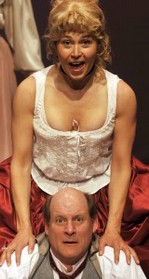
Elizabeth Aspenlieder and Jonathan Croy
(Photo: Kevin Sprague)
|
Not to say that this absurd affair of mistaken identities, infidelities, and class consciousness lacks humor. There are laugh-out-loud situations, but some of them are interrupted by the interminable setting up of the joke. The story calls upon predictable elements of ancient buffoonery: the older doctor, Molineaux, and his young wife Yvonne attended by the sly servant Etienne and the sexy maid Maria, who are all terrorized by a gorgon of a mother-in-law, Madame Aigreville. Mix in the clown/patient Bassinet, a suspicious Prussian husband, Aubin, with a sexually precocious wife and scenes of twentieth century vaudeville appear in front of our eyes. Obviously, the Marx Brothers' use of identity confusion, slamming door humor and the clueless Margaret Dumont were informed by Feydeau's homage to even older comedic schools.
The characters, like most humans, are the victims of their own machinations and deceits. In fact, Molineaux ruminates over the long history of his particular set of circumstances beginning with his childhood. Some of the twisted logic of the illogical should resonate with those of us who recognize our own foibles in Feydeau's characters.
The voluptuous blonde Elizabeth Aspenlieder is the over-sexed patient, Suzanne Aubin, who inveigles the innocent Molineaux into a situation, which, of course, could have been avoided, if he had just told the truth in the first place. Her lusty performance as a sexual predator who likes to live dangerously under the ever watchful eye of her very, large and jealous husband, stirs the energy on stage to a rollicking, fevered pitch. She is wonderful.
Michael F. Toomey as the bumbling patient Bassinet, barges into a situation where he is unwelcome, and, of course, causes untold mayhem. Toomey is a master of comic timing and twittering innocence. His Bassinet's meddling inquisitiveness is also the catalyst for much of the brilliant, frenetic stage business.
Etienne, played by Dave Demke, is the calculating servant who handles his role with that smarmy wit that appears in the farces of ancient Rome and the Commedia dell' Arte. Etienne always seems to be a little wiser than the other characters, especially his master, yet, in the end, he is just another puppet involved in the grand confusion of life.
These three dynamic performers share the stage with a cast that includes veteran Shakespeare & Co. actors Jonathan Cory and Annette Miller, who, regrettably, do not look comfortable in their roles as the doctor and mother-in-law.
The costume designer, Govanne Lohbauer, has created luscious costumes of the Parisian Belle Epoch (1871-1915.) Carl Sprague's set is a beautiful piece of art in its own right with clever and adaptable design elements. The lighting by Les Dickert bathes the stage in a rosy glow of nostalgic gaiety.
Because this is early in the play's summer run, the cast will have a chance to tighten up some of the timing and buffoonery as they become more familiar with the work. Charles Morey should continue to whittle away at this play in order to fine tune it into a more tightly honed, commentary on life.
The Ladies Man is a pleasant little romp. A fine chance to see the origins of the American sitcom.
Addendum: The Ladies Man 2 months later
Unlike its neighbors putting on shows during the summer season, Shakespeare & Co gives its plays a chance to settle in for extended runs, and the actors to fine tune their performances. On the other hand, this poses its own challenge: Scenery must be created to easily come and go since a show must generally run on an alternating schedule with several others. Thus when the last of the five doors slams at The Ladies Man, the set must make way for Othello, which in turn must make way for All's Well that Ends Well (reviews further down on this page). Carl Sprague's set which can be conveniently assembled and disassembled and yet has sturdy enough doors to withstand all the action, is thus a major star of this irreverent homage to Feydeau, with a tip of the hat to Moliere.
The quick change set-up opens the door -- or rather doors-- for the zany in and out the door antics of The Ladies Man's energetic cast. Extra energy is a must for the several actors who also appear in Othello (Elizabeth Aspenlieder not only throws herself with zestful abandon into the hapless Molineux's arms, but plays similar sex games with Cassius).
Seeing The Ladies Man two months into its run and just a week after reviewing A Flea In Her Ear at Williamstown (review), it was fun to see how Morey worked some of the famous comic business from that most famous Fedeau play into the lesser known Tailler pour Dames. The consonant challenged nephew has metamorphosed into the lisping Bassinet. The erectile disfunction and suspenders that arouse a wife's suspicion about her husband's fidelity are now a glove and a word that reduces passion to giggling.
It's all broader and with little concern for the more famous Flea in Her Ear's underlying social commentary. Morey and the Shakespeare& Co farceurs are less interested in meaning than knee-slapping low comedy, so Gloria Miller's hope that Morey might whittle away at this play in order to have a more tightly honed, socially conscious comedy seems to have gone unrealized. The high point of the two hours -- a massive door slamming scene ending in an ensemble can-can-- is still followed by a too long somewhat anti-climactic finale.
Annette Miller and Jonathan Croy didn't strike me as uncomfortable in their roles, so perhaps there has been some fine tuning in those performances. Croy remains a distinctly American sounding Molineux, perhaps that's just director Coleman's way of thumbing his nose at making a serious attempt at authentic Fedeau by letting the accents fly ever wich way and giving audiences some unapolegetic silliness.
THE LADIES MAN
Freely adapted and translated by Charles Morey from Georges Feydeau's Tailleur pour Dames
Directed by Kevin G. Coleman
Cast: Elizabeth Aspenlieder (Suzanne Aubin), Jonathan Croy (Dr. Hercule Molineaux), Dave Demke (Etienne), Annette Miller (Madame Aigreville), Caley Milliken (Marie), Michael F. Toomey (Bassinet), Julie Webster (Yvonne Molineaux), Walton Wilson (Walton Wilson)
Set Design: Carl Sprague
Lighting Design: Les Dickert
Costume Design: Govanne Lohbauer
Sound Design: Michael Pfeiffer
Running time: 2 hours, 15 minutes (one intermission)
Wednesday-Saturday 8:00 PM; Sundays 3:00 PM; Reviewed by Gloria Miller based on June 1st Performance May 23 - August 31
|
REVIEW FEEDBACK Highlight one of the responses below and click "copy" or"CTRL+C"
Paste the highlighted text into the subject line (CTRL+ V): Feel free to add detailed comments in the body of the email. |
All's Well That Ends Well
|
I can cure a monarch's sickness But cannot cure my own. — a line included in one of the songs enlivening this new production of All's Well That Ends Well. It applies to the love smitten Helena who does indeed restore health and vigor to the ailing King but finds her scheme to make the man she loves her husband backfires. |
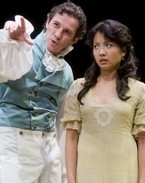
Jason Asprey as Bertram and Kristin Villaneuva as Helena
(Photo: Kevin Sprague )
|
The reasoning for Packer's music infused production of this rarely produced play is sound. Audiences have come to expect her company's Shakespeare presentions to be lively and pleasing to all ages which is certainly the case here. Moreover, this is a play that seems to demand something new and different to justify putting it on since it's a primary example of what directors and Shakespeare scholars often tag as problem plays.
All's Well fits the problem play tag because it defies easy classification or presentation as comedy or tragedy, history drama or romance. It's also problematic because Bertram, the romantic lead's snobbish refusal to wed a wife beneath his social status makes him almost hopelessly unsympathetic. Helena too is a flawed heroine. Her love seems misplaced and is thus hard to root for and for some her way of asserting herself and achieving that "all's well " ending, tends to make her come off as deceitful.
The two productions of the play we've reviewed —-the most recent by the Theater for New Audiences in 2006 and the other one ten years ago, when Shakespeare & Company was still on Plunkett Street— confirm that the play compels directors to attempt a fresh and different take to overcome the difficulties stemming from its failure to settle into an easily definable genre and a second act that lacks the sublety to make the "all's well " ending completely persuasive.
Normi Noel, who directed the play in 1998 sought to "release" Bertram and Helena from what she saw as an inability to speak their true feelings by drawing on Boccaccio whose The Decameron inspired All's Well. Director Darko Tresnjak's vision called for making the comic elements subservient to the tragedy inherent in the basic plot. While both productions had much to commend them, neither was perfect. In Tina Packer's version, comedy is back in the limelight and, while it doesn't get off scot free in terms of the problem play tag (nor does it raise the play's standing on the low run of the Bard's canon), it's certainly great fun — for both the audience and the usually non-singing actors whose solos, duets and ensemble turns enliven the production whenever one's interest tends to flag.
Packer's buildup of the troubador and the original play's single song to ten was inspired by the fact that Rossillion, which is located in the south of France, is the birthplace of the troubador tradition of singing poetic stories. It's her high concept device for dealing with the mix of fairy tale, magic cures, violence and buffoonish comedy as well as to strengthen the second act. She also mixed up the periods for the various elements of the plot which works reasonably well.
Those familiar with the play will see that the basic story remains intact: Helena (Kristin Villanueva), the young daughter of a physician, grows up in the house of the Countess Rossillion (Elizabeth Ingram), a playmate of. young Count, Bertram's (Jason Asprey). Her grownup love for him is unreciprocated. Bertram takes off for more excitement at the court of the king of France (Timothy Douglas). The king's serious illness, l gives Helena a chance to cure him using knowledge gained from her father upon which the grateful monarch offers her an opportunity to marry any of his eligible courtiers. Not surprisingly, she chooses Bertram. Insensitive young snob that he is, he objects to marrying a commoner but the King forces the issue. And so, while wed he must, consummating the marriage is another matter. Instead of bedding his wife he seeks adventure by going off to the Tuscan wars, leaving her this farewell letter: "When thou canst get the ring upon my finger, which never shall come off, and show me a child begotten of thy body that I am father to, then call me husband." The devastated Helena becomes a pilgrim. Though she may seem foolish for loving a man not worth loving, she's a Shakespeare woman with plenty of guts. Her travels take her to Florence where she takes advantage of Bertram's youthful womanizing by getting a lovely blonde Italian maid (Brittany Morgan, another attractive company newcomer) to help her trick him into giving her the ring— and a baby. From there it's back to Rosillion court where all ends per the much quoted title.
Naturally, the above is a mere outline for the complications and machinations unspooled over the course of almost three hours. The musical elements begin even before the action begins and include some spirited dancing choreographed by movement director Susan Dibble.
While the troubador concept can feel a bit forced, its enjoyment is boosted by the enthusiastic participation of the entire cast. That cast is too large to comment on all individually. As the world weary troubadour, Nigel Gore is no James Taylor, Bob Dylan or Pete Seeger, but he offsets his short comings as a singer by bringing his skills and presence as an actor to Lavache's rockstar persona. Kristin Villaneuva, a newcomer to the company, is is a delightful Helena. Jason Asprey's portrays Bertram with the required youthful bravado. Standouts among the older characters are Elizabeth Ingram as the Countess who, unlike her son, welcomes Helena into the Rsillion family; also Timothy Douglas as the King. In the comic department, Kevin O'Donnell is the production's scenery chewer as Parolles. Costume designer Jacqueline Firkins has an especially good time with his outfit. (Where did she find those great red Wellies?).
Set designer Susan Zeeman Rogers uses three rotating panels at the rear of the stage to manage the shift of the action between the Rossillian court, to the French Court to Florence. As always the actors use the entire theater to give the audience the sense of being in the midst of the story -- which is what makes an evening at the Founder Theater a treat, even if you're seeing a problem play.
PRODUCTION NOTES:
All's Well That Ends Well
by William Shakespeare
Directed by Tina Packer
Cast: Jason Asprey (Bertram), Peter Davenport (Amor Dumaine, French courtier and brother to Dumaine Soldat), Morganne Davies (Mariana), Timothy Douglas (King of France), Dennis Krausnick (Lfew), Nigel Gore (Lavache), Elizabeth Ingram (Countess of Rossillion), Rondrell McCormick (Duke of Florence), Mike Allen Moreno (First Soldier), Brittany Morgan (Diana), Kevin O'Donnell (Parolles), Ginya Ness (Reynalda), Douglas Seldin (Drummer Boy, Servant to Parolles), Alexander Sovronsky (Dumaine Solda, brother to Amor Dumaine), Andy Talen (Second Soldier), Grace Trull (pregnant neighbor to the widow), Kristin Villaneuva (Helena)
Set Designer: Susan Zeeman Rogers
Costume Designera: Jacqueline Firkins
Lighting Designer: Les Dickert
Composer/musical director: Bill Barclay
Sound Designefr: Michael Pfeiffer
Movement director Susan Dibble
Assistant director: Gina Kaufmann
Voice coach: Margaret Jansen
Text coach: Clare Reidy
Fight director: Ryan Winkles
Musicians: Petger Davenport/ tambourine; Morganne Davis/flute; Elizabeth Ingram/whistling;Rondell McCormick/percussion; Mike Allen Moreno/haronica; Kevin O'Donnell/guitar/Douglas Seldin/poercussions; Alexander Sovronsky/ guitar, violin, mandolin, tin whistle, ocarina, bamboo flute; Andy Talen/guitar, violin
June 20 - August 31
Reviewed by Elyse Sommer at June 27th press opening
|
REVIEW FEEDBACK Highlight one of the responses below and click "copy" or"CTRL+C"
Paste the highlighted text into the subject line (CTRL+ V): Feel free to add detailed comments in the body of the email and state if you'd like your comments published in our letters section. |
|
This is the night / That either makes me or fordoes me quite.
— Iago
|
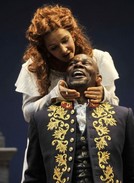
Merritt Janson as Desdemona, John Douglas Thompson as Othello
(Photo: Kevin Sprague ) |
Unlike the other Shakespeare play on offer this season at the beautiful Founders Theater, all's decidedly not at all well at the end of Othello. After three hours of Iago (Michael Hammond) playing nasty mind games with his too trustful boss, Othello (John Doughlas Thompson), the stage is strewn with bodies. Not exactly a barrel of laughs! And yet, as directed by Shakespeare & Company's founding member Tony Simotes, laughter ripples through the audience more often than one would expect.
Simotes was apparently influenced by some scholars for whom the hapless Venetian suitor Roderigo (Ryan Winkles) isn't the play's main source for laughter. Their thinking is that Shakespeare used a traditional comic structure as the foundation stone on which to mount his tragic resolution in order to intensify and sharpen the contrast between light and darkness.
Interesting as Simotes' approach is, having the actors often play their parts for laughs does come at a price of emotional engagement. What's more, by the time all the comic business gave way to the inevitable bloodshed I found myself hard press not to giggle at the enraged Moor's horribly bungled suffocation of what we now call his "trophy wife" (Merritt Janson). You see, as if to settle frequently raised questions as to whether Othello strangles Desdemona with his bare hands or a rope or snuffs out her life with a pillow, Simotes has directed Thompson to handle this as a little bit of everything scenario. First he strangles her. When it turns out she's not dead, he goes for the pillow routine. And as none of the various characters who turn up in the dying woman's bedroom make any attempt to resusitate her, I felt just a little as if I were at variation of Franco Zeffirelli opera and that Desdemona would sit up long enough to sing a final aria.
The good news is, that this year's configuration of the Founders' stage creates a smaller than usual, more intimate playing area . This works very well for this production which has several in its 11-actor cast doubling up as soldiers and, as is usual with this Company, avoids prop-heavy scenery. But rest easy. The one prop which is a pivotal device in this play —the all-important hankerchief Othello inherited from his mother and gave to his new bride is there and made much ado of as a means of feeding Othello's escalating suspicions about Desdemona's fidelity. And, oh, yes, a bed does appear for the grim finale, and the upper gallery area at the rear of the stage is, as always, used most effectively. The small footprint on which the plot unfolds also suits the nature of this tragedy.
No matter how Othello is staged, its enduring fascination is in watching the Moor 's amazingly swift capitualtion to the green monster and Iago's equally amazing display of unremitting villainy. Both these characters are so crucial to the story that Shakespearian actors often yearn to take on both parts. The actor playing Iago often gets the lion's share of praise. However, this is not so in this production.
John Douglas Thompson's Othello is definitely the star at the Founders. His portrait of this complex character is finely shaded. We first meet him as an imposing military leader who seems self-confident enough to deal with the racism engendered by his marrying the fair-haired Desdemona. Yet, his being an outsider clearly makes him vulnerable to the suspicions Iago plants in his mind. A slight African accent, adds richness to this actor's always excellent delivery of the Bard's lines.
Michael Hammond is certainly as nasty a piece of work as you could want but his performance is more competent than mesmerizing. He is too old for a part that calls for the sort of sexual undercurrents that made Liev Schreiber such a rivetingly unforgettable villain.
Mr. Simotes elicits good performances from the women. Merritt Janson is a pretty and sweetly submissive Desdemona, though I would have liked to see her project a bit more of a young wife's awareness of the sexual power she has over her besotted with love older husband. Kristin Wold is a bit bland at first as Desdemona's attendant and Iago's neglected and doomed wife, but she gains considerable strength in the final act. Elizabeth Aspenlieder is a luscious looking Bianca (despite a horrid wig) for whom movement director Susan Dibble has created a colorful Carmen-like dance scene. The standout male support player is LeRoy McClain as Cassius. Casting a young black actor as Othello's suspected rival smartly ramps up the May-December marital drama.
Othello doesn't have the grand battle scenes, colorful witches or an exiled king roaming a stormy country side. But, with or without newfangled directorial ideas, it remains a powerful study of one man driving another to bid farewell to his tranquil mind.
PRODUCTION NOTES:
Othello
by William Shakespeare
Director and Fight Director: Tony Simotes
Written by William Shakespeare
Cast: Elizabeth Aspenlieder (Bianca), Jonathan Croy (Lodovico/Soldier), Michael Hammond (Iago), Merritt Janson (Desdemona), LeRoy McClain (Cassio), Tom Rindge (Duke of Venice/Soldier)), John Douglas Thompson (Othello), Michael F. Toomey (Montano/Senator/Soldier), Walton Wilson (Brabantio/Soldier), Ryan Winkles (Roderigo), Kristin Wold (Emilia)
Set Designer: Yoshi Tanokura
Costume Designer: Gail Brassard
Lighting Designer: Les Dickert
Composer/Sound Designer: Scott Killian
Movement director: Susan Dibble
Voice & text coach: Malcolm Ingram
Production Stage Manager: Hope Rose Kelly
Reviewed by Elyse Sommer July 25th
July 18 - August 31; opening July 25
|
REVIEW FEEDBACK Highlight one of the responses below and click "copy" or"CTRL+C"
Paste the highlighted text into the subject line (CTRL+ V): Feel free to add detailed comments in the body of the email and state if you'd like your comments published in our letters section. |
Elayne P. Bernstein Theatre:
The Goatwoman of Corvis County
|
I want to be a good mother, but I just can't seem to get to it— Charlotte |
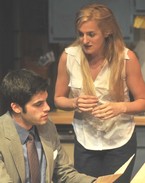
Keira Naughton as Charlotte, The Goatwoman of Corvis County.
(Photo: Kevin Sprague) |
The new theater: Shakespeare & Company's beautifully designed second stage named for one of its most devoted supporters. The new play: A contemporary American gothic. The new playwright: A Shakespeare & Co. member who's moved from being on stage, to creating a play for her fellow actors.
Having followed this actor-manager company for close to twenty years, I'll start this review with a big bravo, brava, congratulations and good luck! The new theater is magnificent— from the handsomely landscaped grounds, complete with a small pond, leading into the spacious lobby to the flexible, technically state-of-the-art performance space.
The sale of the Springlawn Mansion that became Shakespeare & Company's second stage after the move from Edith Wharton's estate to its present location, called on the company's utmost resourcefulness to make the Founders Theater serve as both main and second stage. For proof that their can-do spirit triumphed you need only look at this summer's program which sandwiches a French farce between two Shakespeare plays. The addition of the new theater should enable Shakespeare & Company to once again offer theater goers a full menu of Shakespeare as well as new plays.
So much for my huzzahs for the new venue. What about the play chosen to christen it?
Christine Whitley has written a gritty Southern melodrama that's often funny but ultimately a sad commentary on the family values we all like to think represent American society. True to its Southern gothic roots, the plot's denouement brings to light a darker than dark secret.
Charlotte (Keira Naughton), the title character is as eccentric as the Magrath sisters in Beth Henley's Crimes of the Heart, (review of last year's WTF production). But while that comparison is underscored by Whitley's also having a main character facing a criminal charge, Whitley is more of a take no prisoners playwright, à la Sam Shepard. Charlotte, her husband Randy (Thomas Kee) and son David (David Rosenblatt) from a previous marriage, take the dysfunctional family drama to a new high —or, to be precise, a new low. Not characters for whom one can envision a happy ending!
Charlotte is a woman with a pitifully damaged psyche, who fascinates even though she's not someone who's easy to sympathize with. Randy is your typical redneck — an older, somewhat more prosperous Stanley Kowalski (he owns his own construction company). Like Othello on stage at the Founders Theater, he's easily consumed by the green-eyed monster. Charlotte's son David is the stunted and unlikely to blossom branch of the gnarled family tree.
When I saw the title listed in the company brochure it evoked an image of a somewhat other worldly woman, a sort of horse whisperer for goats. Actually, Ms. Whitley's Goatwoman is not in the least other worldly. She's ditzy and eccentric, but very much a product of a society that values owning things and looking good (Charlotte's mantra is "There's nothing wrong in looking good before you go out" ). Whitley leaves it up to the audience to imagine the childhood that made Charlotte so needy for possessions but it's clear that she's always relied on men rather than an education to give her the life she craves. And so, at thirty-six she's on husband number five who's obviously also disappointed her. The closest he's come to moving her out of the marriage #4 apartment on top of a barn, is to build her the private"vanity room" to which she retreats often enough to give us a poignant look into her fragile soul.
So how does the Goatwoman title tie in with the vain, self-absorbed, born-to-shop Charlotte? It seems that she and husband number four were attracted to the more quiet and bucolic life of a country property which was within commuting distance of his podiatry practice in Nashville. When they bought some goats to clear the brush and Charlotte discovered that she had a way with curing their ailments -- a talent that made her something of a local celebrity and resulted in the Goatwoman label.
Unfortunately Charlotte's ability to heal sick goats does not extend to healing her own self-destructive behavior or nurturing her mothering skills. By the time the plot-driving question of how and whether Charlotte can extricate herself from the charge of short-changing the charity consignment shop she worked for, it turns out that there are even darker aspects to the obsessive vanity and marrying often but not well.
While the big secret that serves as the play's climax comes rather late and without adequate clues planted to make for a totally satisfying ending, Ms. Whitley has created characters who are fascinatingly awful and frequently funny.
The title role is a gift to the actor playing her. Keira Naughton, who's appeared frequently on various Berkshire stages, makes more than the most of that gift. Besides getting the Southern-speak down pat she's funny, sexy, crafty and tragic. While it's pretty much Naughton's play, she gets strong support from Thomas Kee who convincingly segues from Randy's alpha male bluster to begging for affection; also from David Rosenblatt as the son who is the character you'll wish you could save from a bleak future. The fourth character who once again brings Crimes of the Heart to mind, is the young lawyer who makes several house calls pertaining to the charges Charlotte faces. Daniel Berger-Jones does as much as he can with this minor part.
Director Robert Walsh keeps everything humming along. With the help of lighting designer Matthew Miller, the several memory scenes are smoothly and clearly integrated into the present day action.
Susan Zeeman Rodgers' set is the least appealing and effective aspect of the production. Charlotte's vanity room somehow seems too stage-y. Most importantly, since the current configuration of the theater is a three-way thrust, people sitting at the side closest to the entryway are likely to have an obstructed view of that room, and possibly part of the kitchen. Since seating is general (you pick your seat when you go in), I'd advise arriving early enough to nab a center section seat. As this new theater comes into regular use, directors and designers will no doubt deal with problems like this so that everyone of the 166 seats will enjoy perfect sightlines. In the meantime, wherever you sit and whether you have a sick goat or not, you'll want to visit this new theater and get to know the The Goatwoman of Corvis County.
PRODUCTION NOTES:
The Goatwoman of Corvis County by Christine Whitley
Director: Robert Walsh
Cast: Keira Naughton (Charlotte), Thomas Kee (Randy), David Rosenblatt (David), Daniel Berger-Jones (John) Set Designer: Susan Zeeman Rodgers
Lighting Designer: Matthew Miller
Costume Designer : Govane Lohbauer
Sound Designer/ resident Music Director: Bill Barclay
Dialect Coach: Judith Jablonka
Stage Manager: April Carmack
August 1 to 31
Reviewed by Elyse Sommer August 8th.
|
REVIEW FEEDBACK Highlight one of the responses below and click "copy" or"CTRL+C"
Paste the highlighted text into the subject line (CTRL+ V): Feel free to add detailed comments in the body of the email and state if you'd like your comments published in our letters section. |
by Irina Brook and Michael Hammond; adapted from the fun ghost story for the whole family by Oscar Wilde and directed by Irina Brook.
From September 12 to November 9.