SITE GUIDE
SEARCH
REVIEWS
REVIEW ARCHIVES
ADVERTISING AT CURTAINUP
FEATURES
NEWS
Etcetera and
Short Term Listings
LISTINGS
Broadway
Off-Broadway
NYC Restaurants
BOOKS and CDs
OTHER PLACES
Berkshires
London
California
New Jersey
DC
Philadelphia
Elsewhere
QUOTES
TKTS
PLAYWRIGHTS' ALBUMS
LETTERS TO EDITOR
FILM
LINKS
MISCELLANEOUS
Free Updates
Masthead
Writing for Us
A CurtainUp  London Review
London ReviewArcadia
|
The unpredictable and the predetermined unfold together to make everything the way it is. It's how nature creates itself, on every scale, the snowflake and the snowstorm. It makes me so happy. To be at the beginning again, knowing almost nothing.— Valentine
|
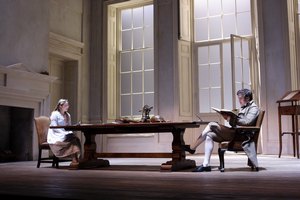
Jessie Cave as Thomasina and Dan Stevens as Septimus Hodge(Photo: Catherine Ashmore) |
The real Arcadia was a landlocked region of Greece where the Arcadians lived a pastoral and isolated existence and in Greek and Roman poetry and Renaissance literature, the term Arcadia is interchangeable with an idealized country living, a kind of rural paradise.
In the course of the play we examine algebra and algorithms, fashions in garden design, Byron's peccadilloes and many more possible diversions that the playwright allows us to expand mentally. The key with Stoppard is the way he satisfies so many of the audience and how detailed is his immaculate research. Those who want to observe people are satisfied, those who want to chuckle will find plenty to amuse but those whose want to grapple with scientific concepts can do so without the rest of us who may be non scientists feeling adrift. In the scene towards the end of the play when both time periods happen at once, the twenty-first century cast are dressed for a costume ball so the dress is similar to their ancestors.
There is plenty of Stoppard's famously clever wit, whether it's Septimus gulling Thomasina into thinking carnal embrace is the practice of throwing one's arms round a side of beef or Lady Croom wryly observing, "It is a defect of God's humour that he directs our hearts everywhere but to those who have a right to them." The disastrous gardener Mr Noakes is compared unfavourably with the most brilliant of eighteenth century landscape designers, Capability Brown, by his being dubbed Culpability Noakes by Lady Croom. It is Noakes' work which is changing the gardens of Sidley Park from the natural but romantic Arcadia to the over styled Gothic.
The casting is very skillful. Neil Pearson is the almost unsavoury university lecturer determined to make his name with an ill-researched force fit theory about Byron. Samantha Bond, who sounds more and more like Judi Dench with that delicious crack in her voice, is the more scrupulous writer and garden historian. Nancy Carroll is a quirky and quite delightfully outspoken Lady Croom. Her acerbic exchanges with Noakes about The Hermitage are a complete joy but on the subject of Mrs Chater's drawers, she is also naughty. A handsome and confident Dan Stevens takes on the part of the tutor that Rufus Sewell made hearts a flutter in 1993 and is of course the object of his tutee's romantic notions. Ed Stoppard is excellent as the socially awkward, "head in the clouds" Valentine. Jessie Cave as Thomasina could be difficult to hear on the night I saw the play but is very natural and has promise.
The Duke of York has installed an extra lighting rig for this play which makes the set really beautifully lit by Paul Anderson, with Hildegard Bechtler's classical drawing room with beautiful furniture and lovely windows at the rear, but it also makes the theatre very hot as the antiquated air conditioning struggles to cope and patrons start distractingly to fan their programmes against the heat.
This is the most entertaining and witty play in London's West End. Do not miss David Leveaux's delightful production!
For more about Tom Stoppard and links to other Stoppard plays we've reviewed, see Curtainup's Stoppard Backgrounder.
| Arcadia
Written by Tom Stoppard Directed by David Leveaux Starring: Nancy Carroll, Samantha Bond, Neil Pearson, Ed Stoppard, Dan Stevens With: Sam Cox, Jessie Cave, George Potts, Trevor Cooper, Tom Hodgkins, Lucy Griffiths, Hugh Mitchell Set Design: Hildegarde Bechtler Costume Design: Amy Roberts Lighting: Paul Anderson Sound: Simon Baker for Autograph Music: Corin Buckridge Choreographer: Scarlett Mackmin Running time: Two hours 45 minutes with an interval Box Office: 0870 060 6623 Booking to 12th September 2009 Reviewed by Lizzie Loveridge based on 5th June 2009 performance at the Duke of York's, St Martin's Lane, London WC2 (Tube: Charing Cross) |
|
REVIEW FEEDBACK Highlight one of the responses below and click "copy" or"CTRL+C"
Paste the highlighted text into the subject line (CTRL+ V): Feel free to add detailed comments in the body of the email . . . also the names and emails of any friends to whom you'd like us to forward a copy of this review. |
|
London Theatre Tickets Lion King Tickets Billy Elliot Tickets Mighty Boosh Tickets Mamma Mia Tickets We Will Rock You Tickets Theatre Tickets |