
SITE GUIDE
SEARCH
REVIEWS
FEATURES
NEWS
Etcetera and
Short Term Listings
LISTINGS
Broadway
Off-Broadway
NYC Restaurants
BOOKS and CDs
OTHER PLACES
Berkshires
London
California
New Jersey
DC
Philadelphia
Elsewhere
QUOTES
TKTS
PLAYWRIGHTS' ALBUMS
LETTERS TO EDITOR
FILM
LINKS
MISCELLANEOUS
Free Updates
Masthead
Writing for Us
CurtainUp Reviews
The Berkshire Theatre Festival's Summer 2008 Season
By Elyse Sommer
|
|
Main StageShows:*Candida |*The Book Club Play |*A Man for All Seasons|*Noël Coward in Two Keys
Unicorn Theater Shows:*The Caretaker|*Pageant Play|Waiting for Godot|Eleanor: Her Secret Journey|
Theatre for Your Audiences: Hercules |Around the World in 80 Days |Oliver
About this All-In-One Format: Since summer theater productions run such a short time, instead of retiring each show after it makes way for the next production, we're putting details and reviews of shows at a particular theater on one page so that everything remains at your fingertips. No need to click to the archives unless you are looking for something from a past season.
The list is organized in order scheduled. A list of Berkshire Main Stage Productions is followed by a list of productionss to be performed at the smaller Unicorn theater. A click on a show will jump you down to that show's details-- an * asterisk before a title indicates that a review is posted.
Berkshire Theatre Festival
Stockbridge, MASS
413-298-5576
Berkshire Theatre Festival Main Stage performances are Monday through Saturday evenings at 8pm with 2pm matinees on Thursdays and Saturdays. Tickets range from $23 to $68. Unicorn performances are Monday through Saturday evenings at 8pm, with 2pm matinees on Saturdays for most shows. Tickets range from $19.50 to $44.
Main Stage Shows Candida
| Nothing that's worth saying is proper. --- Eugene Marchbanks |
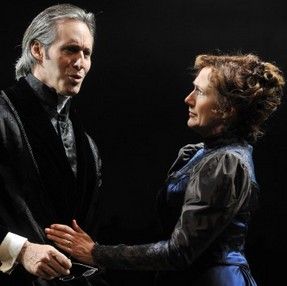
Jayne Atkinson and Michel Gill
(Photo: Kevin Sprague)
|
For those unfamiliar with the story, it confirms that Shaw was way ahead of the curve in his appreciation of women as more than decorative chatelaines. Candida is a marital triangle very much à la Shaw. The Reverend James Mavor Morell (Michel Gill) is a pastor with an increasingly high profile as a dynamic and much in demand public speaker, notwithstanding the fact that he's essentially a "moralist windbag" with what he has to say not really adding up to anything all that substantial. (Think of some of our present day politicians whose well-educated wives tend to minimize their own careers and put the marital corporation's larger aims above their own needs).
As the play opens Morrell's wife Candida (Jayne Atkinson, who's also Gill's off-stage wife) is returning from a three week holiday. She is accompanied by a the well-born, super sensitive eighteen-year-old poet, Eugene Marchbanks (Finn Wittrock), who's become a family friend. But Marchbank, for all his childlike awkwardness turns out to be the catalyst to disrupt the domestic tranquility of the Morell household, exposing in just one day, years of a man taking his wife's love for granted and that wife keeping any discontent under wraps.
What leads to the exposé of the shadows beneath the surface of this seemingly perfect marriage is Marchbank's declaration that he's passionately in love with Candida. The still more boy than man poet is hardly the sort of white knight likely to entice Candida to slam the door of the Parsonage, shades of Ibsen's Nora. However, his declaration does make a dent in Morrell's heretofore impenetrable happiness. Thus the first act is mostly a verbal duel between between Morrell and Marchbank and gradually reveals Candida to be someone much more complex than the woman both men have placed on a pedestal to fit their ideal of the perfect woman.
Thus, when the play bursts into full bloom in the second act, we see that this is more about the institution of marriage than choosing between a husband of many years and a much younger, more attentive man. Candida's choice not so much between two men but whether to opt out of a difficult, demanding marriage or to stick with it and make it work better. Tititan's painting, "The Assumption of the Virgin," which hangs above the fireplace of Morrell's study serves as a metaphor, not just for the men's idealized image of Candida but but for the interrelationship of all three.
Atkinson, while somewhat too old for the part (even though she's here said to be almost forty instead of Shaw's designated thirty-three), is a good enough Shavian interpreter to make this work for her. After all, Candida is a forceful figure who's more maternal than sexy. As for Gill, unlike some actors I've seen in this role who are too unattractive and focused on the moralist windbag persona, he is attractive and charismatic enough to make you understand why Candida was willing to continue spoiling and nurturing him, as his mother and sisters did before her. The character of the tortured boy-man seems at first to cry out for more fair-haired, beautiful actor than Finn Wittrock. But the actor develops a portrait that grows on you and shows Marchbank ready to abandon boyhood for manhood.
The actors playing the three minor characters make major contributions—Jeremiah Wiggins as Morrell's Curate, David Schramm as Candida's father and Samantha Soule as the Reverend's typist. Soule is especially outstanding. Her Prossy is convincingly uptight and so adorable as the young woman secretly smitten with the boss that you wish Reverend Mill could turn into a Prince Charming to put some real romance into her life.
Anders Cato once again proves that he knows how to give fresh life to classic plays. Hugh Landwehr has not only created a beautifully detailed study for the play's single set, but backed it all with a wonderful image of the trees and streets just outside the parsonage. Olivera Gajic has dressed the cast in period perfect costumes. Scott Killian rounds out the excellent production values with suitable intra-scene music.
The two intermissions usual in Shaw's day have been conflated to one break between the second and third act. And so, talky as the first act may be, the action starting with Candida's return to the parsonage and ending with her choice that isn't really a choice, pass by quicker than you can say "Bravo!"
For more about George Bernard Shaw and links to other plays by him that we've reviewed, check out our Shaw Backgrounder.
Candida
by George Bernard Shaw
Directed by Anders Cato. Cast: Jayne Atkinson (Candida), Michel Gill (Reverend James Mavor Morell), David Schramm (Mr. Burgess), Samantha Soule (Miss Proserpine Garnett), Jeremiah Wiggins (Reverend Alexander Mill), and Finn Wittrock (Eugene Marchbanks)
Stage Manager: John Godbout
Scenic Designer: Hugh Landwehr
Costume Designer: Olivera Gajic
Composer/Sound Designer: Scott Killian
Dramaturg: James Leverett
Dialect Coage: David Alan Stern
Running Time: 90 minutes, plus one 15-minute intermission (act 1-55 minutes, act2-35 minutes)
From June 17 to July 5. Opens June 20.
Reviewed by Elyse Sommer September 20th press opening
|
REVIEW FEEDBACK Highlight one of the responses below and click "copy" or"CTRL+C"
Paste the highlighted text into the subject line (CTRL+ V): Feel free to add detailed comments in the body of the email and state if you'd like your comments published in our letters section. |
The Book Club Play
|
Studies show Book Club is code for hanging out— NPR commentator, one of The Book Club Play' the play's numerous Talking Heads. People in book clubs probably know the characters in books better than their friends.—Alex. |
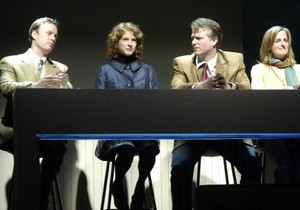
Tom Story, Anne Louise Zachry, C.J. Wilson, and Keira Naughton. (Photo by Kevin Sprague)
|
When octogenian Helen Santmyer's novel . . .And Ladies of the Club was published in 1982 it sold millions of copies and it's still in print, justly praised as a serious work of historic fiction. While the members of playwright Karen Zacarias's modern day book club discuss such substantive books as Moby Dick and War and Peace, the play itself falls into the more ephemeral category of a light summer read, its focus on keeping the laughs coming and any serious subtext under wraps.
Light summer entertainment isn't necessarily a bad thing. Whether you're a book club member or not, seeing The Book Club on a lovely July evening makes it easy to give oneself over to its humor and forgive the failure to realize the pervasive book club scene's potential as a broader satire of its upper middle class participants' manners and mores. Given Nick Olcott's splendidly acted, stylish production (especially enhanced by Shawn E. Boyle's projections), you're also likely to buy into the play's stylistic conceit that the book club meetings you are witnessing are actually being filmed as a documentary; in other words, what you're watching is a play within a film.
The filmic device, while ultimately too gimmicky, does add a layer of commentary on our voyeuristic world. On the one hand the awareness of being on camera puts the club members on their mettle to show off their literary smarts. Yet, it's evident that people quickly get used to the presence of the camera so that it in no way prevents the group's dysfunction from exploding.
The chief personalities propelling the play's funny business are the book club's founding members. First on stage is Will (Tom Story), who guards his sexual preferences as carefully as the objects in the museum where he works. Next we meet Ana (Keira Naughton) who was once his girl friend and her husband Rob (C. J. Wilson), Will's erstwhile hunky college roommate— and the one member for whom the meetings are more about the pre-discussion dinners than the books (unless it's Son of Tarzan).
While Will lays claim to having founded the club, it's the controlling and self-important Ana who dominates as the club's Queen Bee. She's brought Jen (Anne Louise Zachry), a bright but currently underachieving single woman into the fold, but only after Jen's career has run into problems as Ana's has moved forward. Ana also welcomes Lily (Cherise Boothe), a lively African-American woman as a means of introducing more diversity into the group. The Lily/Ana exchanges after the former has been "vetted" come closest to that unrealized broader satiric potential.
The last to join this tight little literary circle is Alex (Bhavesh Patel). Good as all the actors are, Patel steals every scene he's in. He's also the one who blows the lid off the group's unity and prompts Ana to completely give in to her control freak tendencies. And, to cause further mayhem, there's a discussion of The Age of Innocence and more troublesome still. a book not to be found on any library shelf. Far be it from me to spoil things with more plot details.
To further support the documentary setup, the club meetings are interspersed with commentaries by various expert/pundits — an NPR commentator, a Walmart manager, a drunken and frustrated writer, a former Secret Service agent, a Williams College co-ed and, best of all, a literary agent grumbling (not without justification) about too many books being published each year. All are hilariously portrayed by Sarah Marshall. All are brought into the amusing epilogue. Marshall's virtuoso versatility notwithstanding, at least a few would not be missed if eliminated, and thereby bring the play in without an intermission. On the other hand, R. Michael Miller's generic set, though suggesting a cocktail lounge rather than an apartment, efficiently serves the purpose of moving the meetings to different apartments without fussy scenery changes.
BTF's artistic director Kate Maguire is to be commended for giving Berkshire theater goers a chance to see new plays instead of just time-tested revivals. Interestingly, the authors of both Pageant Play currently at the Unicorn and The Book Club Play have opted to explore two types of endeavors that are very much part of our current cultural zeitgeist, and do so with a focus on comedy. Both plays are far from perfect, but being handsomely produced and mounted with fine actors, gives their authors the much needed opportunity to perfect their craft. What would we do without regional theater?
PRODUCTION NOTES
The Book Club Play by Karen Zacarias
Directed by Nick Olcott
Cast: Cherise Boothe (Lily), Keira Naughton (Ana), Bhavesh Patel (Alex),Tom Story (Will), C.J. Wilson (Rob), Anne Louise Zachry (Jen(.
Scenic designer: R. Michael Miller
Costume designer: Laurie Churba
Sound designer: J Hagenbuckle
Lighting designer: Ann G. Wrightson
Projection designer: Shawn E. Boyle
Running Time: Approximately 2 hours with an intermission
Reviewed by Elyse Sommer on July 13th
From July 8 to July 19. Opens July 11.
|
REVIEW FEEDBACK Highlight one of the responses below and click "copy" or"CTRL+C"
Paste the highlighted text into the subject line (CTRL+ V): Feel free to add detailed comments in the body of the email and state if you'd like your comments published in our letters section. |
A Man for All Seasons
|
. . .to thine own self be true, and it shall follow, as the night the day, thou cans't not then be false to any man.— Hamlet, Act I, Scene III
More is a man of an angel's wit and singular learning. I know not his fellow. For where is the man of that gentleness, lowliness and affability? And, as time requireth, a man of marvelous mirth and pastimes, and sometime of as sad gravity. A man for all seasons.— Robert Whittington's comment about More in 1520 from which Robert Bolt borrowed the title for his play. |
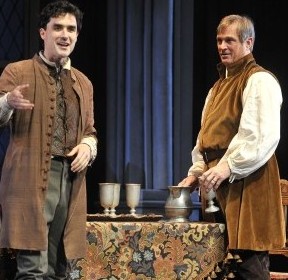
Tommy Schrider & Eric Hill in A Man for All Seasons
(Photo: Kenneth Sprague)
|
Of course it isn't etched in stone that all new plays must fit this time frame and small casting scale. Just this year Chicago playwright Tracy Letts nabbed a Pulitzer last season with his 13 member cast, 3-hour August Osage County. But plays clocking in at less than two hours and with just two or three actors, have definitely won favor with audiences and the authors writing them. Any play mounted with a big cast and running close to or even more than three hours is more often than not a revival.
My last three playgoing ventures are a case in point. Theresa Rebeck's new play, The Understudy, which opened last Thursday at Williamstown (my review ), proved once again that if you have a good idea and a knack for smart dialogue, it will take just ninety minutes and a few actors to create a satisfying and entertaining theater piece.
Othello seen Friday at Shakespeare & Company, took three hours for Iago's deadly mind games with Othello to conclude with its clutter of dead villains and victims. Saturday was yet another long night with Berkshire Theatre Festival's revival of Robert Bolt's A Man For All Seasons which took even longer (3 hours and 10 minutes) to put Sir Thomas More's stubborn head on the executioner's block. I doubt I'm being a spoiler here, as this forty-six-year old play is based on a well-known true story and has been filmed, revived and included in school curriculums as a history and ethics lesson.
While Bolt was an agnostic, his choice of More, a devout Catholic, to portray an unltimate man of conscience has as much power as ever to resonate with modern audiences. Powerful and pertinent as A Man For All Seasons still is, however, it's also ponderous with all all the talk about religious issues of the day (1530s England) too often overshadowing the fact that this is also a very personal riches to rags family drama.
The slow-moving first act, which is mainly a setup for introducing all the characters had more than a few people at Saturday' night's performance nodding off. It had me wishing that Bolt, after trimming his play by an hour for the film (still a popular DVD), would have gone back to the stage version with a blue pencil in hand.
Even with its sluggish first act untrimmed and the play overall too talky, it's interesting to revisit what was a groundbreaking play in its day and made Paul Scofield who played More on stage and in the subsequent film a star. The fact that Scofield's charisma and charm are etched in many a theater and moviegoer's memory has not deterred other actors from undertaking the role. The Roundabout Theater is counting on super star Frank Langella to put comparisons with Scofield to rest. In Berkshire Theatre Festival's revival, that challenge is undertaken by Eric Hill, one of the Festival's outstanding directors.
Unfortunately, while Hill is quite moving during More's final days his man of all seasons is not a man who captures the many moods called for. He's so consistently the man of unbending do-the-right-thing belief, that his opportunities to show the man's lighthearted, sociable side come off as forced. Granted that More's wife Alice (Diane Prushka) was written to be as stubbornly devoted to the status quo as More was to being true to his conscience, but as played by Hill and Prushka there isn't a smidgen of marital compatibility here until the farewell scene in which both do manage to stir an emotional spark. More's relationship with his daughter Margaret (Tara Franklin) is warmer but also could let us see more of its being special (he actually had other children but she was his favorite and he educated her more than was usual for women of that period).
Many a play revolving around a saintly hero (More was in fact made a saint by the church), becomes more interesting when the villain enters the action. This is true of King Henry's chief deputy, Thomas Cromwell, the villain in chief who's played by David Chandler with Iago-like malice. Happily, there are several other "bad guys" to pick up the pace. Notable among these men bent on pursuing their own agendas is Gareth Saxe — who's here quite dashing and not the obese monarch usually associated with Henry VIII. Saxe exudes willfulness in his determination to divorce the wife who failed to give him an heir. Even more memorable is Tommy Schrider, who was terrific earlier in the season as one of the brothers in The Caretaker. As the aptly named Richard Rich, he's a young man bent on ascending the ladder leading to riches and power.
Besides taking liberties with certain historical details and conveniently overlooking More's less than saintly persecution of Protestants during his days in power, Bolt used a very effective dramatic device in the form of a multi-purpose Brechtian character he calls The Common Man. This amalgam of minor yet crucial characters— narrator, More's household steward, a boatman, Tower of London jailer, jury foreman and finally, the executioner — are all expertly played by Walter Hudson. His very different characters are not so different in that they all symbolize the "banality of evil." It is these common men who have throughout history failed to do what's right in terms of honor and decency instead of what's right to preserve their own lives.
A stage production makes it impossible to tell a story like this against the sort of panoramic background that only a movie camera can achieve. (I still remember, the atmospheric view of the Thames river at the begining of the Scofield film ). But scenic designer Joseph Varga has managed to create the aura of the various locations, abetted by Matthew E. Adelson's lighting and Scott Killian's mood-setting music. Murrell Horton's cocoa colored costumes for the More family seem to emphasize the one-note quality of their initial interaction. The costumes become more interesting with the appearance of the gold-clad King and are particularly apt in depicting Richard Rich's asscent to the corridors of power.
To sum up, A Man for All Seasons is one of those plays with themes undeniably worth reconsidering —even if , as my London colleague commented about a revival she saw last year, it nowadays feels somewhat more historic than fresh.
PRODUCTION NOTES:
A Man for All Seasons by Robert Bolt
Directed by Richard Corley
Cast: Andrew Belcher (Archbishop of Canterbury), David Chandler (Thomas Cromwell), Douglas Friedman (Attendant), Tara Franklin (Margaret More), Eric Hill (Sir Thomas More), Walter Hudson (The Common Man), Greg Keller (William Roper), Peter Kybart (Cardinal Wolsey), Diane Prusha (Alice More), James Lloyd Reynolds (Duke of Norfolk), Thom Rivera (Signor Chapuys, the Spanish Ambassador), Gareth Sax (King Henry VIII), Tommy Schrider (Richard Rich), Allison Vanouse (The Woman). Audrey Ahern, Jaclyn Bethany, Cameron Spencer Comstock, Mary Caitlin Gilson, Devon Werden, Abigail Ziaja (Ensemble).
Scenic Designer: Joseph Varga
Costume Designer: Murell Horton
Lighting Designer: Matthew E. Adelson
Original Music and Sound Designer: Scott Killian
Stage Manager: Jason Hindelang
Reviewed by Elyse Sommer July 26th
From July 22 to August 9. Opens July 25
|
REVIEW FEEDBACK Highlight one of the responses below and click "copy" or"CTRL+C"
Paste the highlighted text into the subject line (CTRL+ V): Feel free to add detailed comments in the body of the email and state if you'd like your comments published in our letters section. |
Noël Coward inTwo Keys
|
She's nice your wife. I like her. I don't think you did her justice in your autobiography. But then, you weren't very nice about anyone in your book, were you?—Carlotta You're under no obligation to read it.—Hugo There was no warning on the cover—Carlotta |
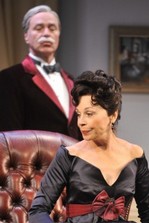
Maureen Anderman and Casey Biggs in A Song at Twilight
(Photo: Kevin Sprague ) |
With Barrington Stage winding up its main stage season with one of Noël Coward's most durable hits, Private Lives, a double bill of Coward's last more rarely performed works promised the sort of symmetry common to this summer's season overall (A Fedeau farce at Williamstown, and a Fedeau adaptation at Shakeseare & Co. . . at least one world premiere at every theater in the area. . . the BTF Unicorn's opening with a play by Harold Pinter and concluding with one by the man who was his spiritual father, Samuel Beckett).
Unfortunately, there's a reason Noël Coward in Two Keys is disappointing. Coward wrote three one-acts to be performed together. The problem was that none of them were ever on a par with his top drawer work and only one, A Song at Twilight, comes close. Thus, even when cut down two instead of three Keys audiences are given just half a loaf whether A Song at Twilight is paired with Come Into the Garden, Maude, as it currently is, or with Shadows of Evening as it was when I last saw it Off-Broadway eight years ago.
The less said about the fifty-minute Come into the Garden, Maude which opens the evening, the better. Except for the fun of seeing the same four actors play completely different characters in quick succession, Maude is a tedious piece, with none of Coward's usual sparkle. The characters seem more as if they've stepped out of one of Henry James's Americans abroad novels or Sinclair Lewis's Dodsworth than out of a Coward script. Except for the dual use of the actors and setting (Michael Miller's aptly elegant Swiss hotel suite), there's little or no thematic connection between the plays and the evening would work better as Noël Coward in one Key.
If Gian Murray Gianino, who plays a waiter in both plays, were a singer and pianist as well as an actor, perhaps the evening could have been filled out by having him perform some of Coward's songs and spare us Come into the Garden, Maud. Since this is obviously not going to happen, all I can say is, hang in there. A Song of Twilight does have enough of Coward's hallmark wit and underlying substance to be worth seeing, and the actors also are much more nuanced than in the too lengthy and lethargic curtain raiser.
Song of Twilight begins with noted author Sir Hugo Latymer's (Casey Biggs nicely nails the stiff upper lip Brit) and his German born wife Hilde (Mia Dillon, who lets us see the strongly beating heart beneath the calmly efficient exterior of a woman who has settled for a marriage of convenience). They're awaiting a visit from Carlotta Gray (a stylishly Cowardesque Maureen Anderman), a mostly retired actress who was once his mistress and is the one who requested the meeting. Hilde has prepared for Carolotta's visit with the same efficiency with which she looks after his health and literary affairs. But to Hugo's dismay the dinner she's ordered is for two. He suspects that Carlotta is up to something and is not particularly anxious for a tete-a-tete and despite the sarcastic disdain he heaps on Hilde, he is accustomed to her being on hand to deal with any unpleasantness.
Though this is really quite a dark song, the play lives up to its billing as a comedy by virtue of the bon mots that fly all over the Latymer's suite even before Carlotta's arrival. But it's after Hilda departs and the dinner she has ordered from the hotel kitchen arrives, and Anderman's Carlotta zestfully attacks the caviar, filet mignon and pink champagne (Hilde's sly replica of Carolotta and Hugo's very first dinner) that the play soars to the heights of its comic potential. The mots Anderman manages to land in between sipping and chewing are pure Coward.
Carlotta's reasons for requesting this reunion is revealed bit by bit (or should I say, bite by bite). It seems she's not quite the silly actress Sir Hugo portrayed her to be in his memoir. In fact, she has landed a contract for her own memoir in which she wants to include his love letters to her. The very proper Hugo objects strenuously, declaring "I have no intention of playing the horse to your Lady Godiva."
But much as Hugo may bluster about Carlotta's wanting to piggyback on his fame, it turns out that Carlotta feels it is he who has used her and someone else from their past. It is to right this wrong that she brings up another set of letters. These are also love letters which if made available to Sir Hugo's biographers would make public too much of his carefully guarded private life.
While Coward didn't advertise his sexual inclination, they're well enough known for many viewers to see the author as the role model for Sir Hugo. However, the more likely role model here is another famous writer, Somerset Maugham. Obviously, whether you identify Hugo's secret life with Coward or Maugham, revelations about homosexuality are hardly newsworthy or shocking today as they were in 1966 when A Song At Twilight was written. But then the climax of this cat-and-mouse game between two former lovers is less about Hugo's sexual proclivites than what they reveal about what makes him what he is — and the way Coward trumps Carlotta's trump card to give his play the sort of poignancy that's never dated.
|
Director Vivian Matalon was kind enough to take the time to shed some light on my statement about the original Suite in 3 Keys. While I stand corrected, I can't help wishing that Twilight would have remained uncut and put on without Maud. Mr. Matalon's comments below:
" The original Suite in 3 Key did not consist of 3 1 act plays. In the original production A Song at Twilight was a full length play performed in 2 acts with a 15 minute interval. This play alternated with a double bill which consisted of "Come into the Garden Maud and Shadows of the Evening. When the plays were to be done in America it was generally agreed that it would be better to drop Shadows and cut Twilight to the length of a longish 1 act, shorten Maud and put them together as a double bill. At Coward's request I did the cutting which he approved and that is the version which played with some success on Broadway and on tour in 74\75." |
PRODUCTION NOTES
Noël Coward in Two Keys Directed by Vivian Matalon
Come into the Garden, Maud
Maureen Anderman (Maud Cargnani), Casey Biggs (Verner Conklin), Mia Dillon (Anna Mary Conklin) Gian Murray Gianino (Felix)
Song at Twilight
Maureen Anderman (Carlotta Gray), Casey Biggs (Sir Hugo Latymer), Mia Dillon (Hilde Laytmer) Gian Murray Gianino (Felix)
Scenic Designer: R. Michael Miller
Costumes: David Murin
Lights: Ken Billington
Wig Master: David Lawrence
Dailect Consultant: Elizabeth Ingram
Running Time: 2 1/2 hours including one intermission
Reviewed by Elyse Sommer August 16th
From August 12 to August 30.
|
REVIEW FEEDBACK Highlight one of the responses below and click "copy" or"CTRL+C"
Paste the highlighted text into the subject line (CTRL+ V): Feel free to add detailed comments in the body of the email and state if you'd like your comments published in our letters section. |
Unicorn Shows The Caretaker
|
You're sure you don't mind me staying here? I mean, I'm not the sort of
man to take any liberties. . .— Davies
|
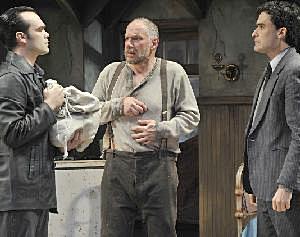
James Barry, Jonathan Epstein, and Tommy Schrider in The Caretaker. (Photo by Kevin Sprague)
|
In the almost half century since The Caretaker added the terms Pinteresque and Pinter Pause to our theatrical lexicon, there's been no pause in productions of Harold Pinter's plays. This past season, his second big success, The Homecoming, received a justly acclaimed Broadway revival. And now, the Berkshire Theatre Festival has launched its summer 2008 Unicorn Theater season with a production of The Caretaker that gets the sinister yet often comic power struggle between three self-deluded men as riveting and right as I've ever seen it.
My last encounter with Aston and Mick, the two oddball brothers, and Davies, the crafty and absurdly fastidious hobo who enters their messy world, was at the Roundabout Theater Company's elegant Broadway home, the American Airlines Theater. The much smaller, comfortable but plain Unicorn theater makes for a more immediate physical connection with these eccentric men and their unspeakably filthy surroundings. The water periodically dripping into the tin bucket suspended from the ceiling now lands like a clap of thunder and feels close enough to make you feel that another leak could easily spring right above your head.
Besides the welcome intimacy of the venue, the production that just opened benefits from Eric Hill's astutely directed, trim production —acts one and two are merged to eliminate the original's two-intermission format, and the whole show clocks in at two hours plus a ten minutes, instead of the above mentioned Roundabout's almost three hours. Best of all, Hill has shepherded a superb trio of actors to fully capture the sense of lurking menace that is a Pinter trademark, as well as the comic absurdity that validates the frequently used descriptive tags of "A Comedy Drama." or "Comedy of Menace."
As the complex hobo, Davies, we have Jonathan Epstein, one of this area's finest and most popular actors. Epstein has uncovered all the humorous aspects of Davies's character without softening the image of a man on the brink of snapping, a man for whom the brothers represent a last desperate chance at surviving with a shred of self-esteem in an untenable world. His accent and expressive body language give Davies an on the mark, vivid authenticity. His cavalier failure to appreciate the shoes and shelter he so desperately needs and his efforts to become the caretaker of that messy tenement makes it clear that he is as much a pipe dreamer as the two brothers he tries to manipulate.
To push Davies' buttons, James Barry and Tommy Schrider (also well known to Berkshire audiences) do splendid work at the deluded brothers. Barry is perfect as the slick-haired, leather jacket clad, thuggish Mick with his unrealistic ambitions to fix up the shabby tenement into a profitable real estate enterprise. Schrider is just right as Auston, the gentle older brother, a former mental patient whose more modest pipe dream is to build a work shed. A monologue during which Schrider describes his mental hospital stay and a forcibly administered shock treatment has the effect of a shock treatment applied to the viewer's heart.
All the famous Pinteresque pauses are in place, including the opening in which a silent Mick establishes the mood with an almost unbearably stretched out pause of all pauses. The action, which is minimal, is prompted by Aston's rescuing Davies from a street fight and offering him temporary shelter. Though it's soon evident that the old bum wants to become a steady rather than a transient guest, he sneers at everything the mild-mannered, smiling Aston offers. Yet you can see a glimmer of dormant self-esteem, as he preens in a velvet smoking jacket. One of the play's comic highlights is a scene when Davies, after turning down a pair of brown shoes as being too pointy, accepts the black ones Aston brings but then complains when his benefactor can only provide brown shoe laces.
Mick is initially hostile to Davies, who in response to his demands to explain who he really is repeatedly talks about getting to Sidcup to get his papers. (Sidcup, according to our London critic, is a suburb of south east London, maybe three hours and several changes of bus away from Chiswick.) Before long Mick too befriends him and, like Aston, offers him a job as the building caretaker. This double job offer feeds Davies' wiliest instincts. Though a power play among three desperate, powerless men is unlikely to end in victory for anyone and there's not the slightest evidence of any sibling feeling between the brothers, in the end it's some sort of blood tie that brings an end to the power play over who will be the real caretaker of this unappealing domicile.
While this production is at the Festival's small, second stage, the production values are first rate— from Jonathan Wentz finely detailed tenement, to Yoshinori Tanokura character defining outfits, to Matthew E. Adelson's atmospheric lighting and J. Hagenbuckle's exquisitely eerie music and sound design.
Though The Caretaker was written at a time when the British were in miserable straits, trying to recover from the basic absurdity of war and the wreckage it leaves in its wake, this old play feels as fresh as the shower Davies so obviously needs. Since the play is generally regarded as directly influenced by Samuel Beckett's Waiting for Godot, you can check out this theory for yourself since a production of Beckett's influential Godot is coming to the Unicorn in August.
For more about Harold Pinter, his style, his work, links to his work we've reviewed—including other versions of The Caretaker that detail how Pinter and his wife actually new of two brothers who took in a homeless man like Davies— see our Harold Pinter Backgrounder.
PRODUCTION NOTES
The Caretaker by Harold Pinter
Directed by Eric Hill
Cast: James Barry (Mick), Jonathan Epstein (Davies), Tommy Schrider (Aston)
Scenic Design: Jonathan Wentz
Costume Design: Yoshinori Tanokura
Lighting Design: Matthew E. Adelson
Composer/Sound Designer: J. Hagenbuckle
Resident Dialect Coach: David Alan Stern
Stage Manager: Stephen Horton
From May 22; Opening May 24. Closing June 28
Running Time: 2 hours (acts I and II, 85 minutes; act III, 35 minutes), plus one 10-minute intermission
Reviewed by Elyse Sommer May 24th press opening
|
REVIEW FEEDBACK Highlight one of the responses below and click "copy" or"CTRL+C"
Paste the highlighted text into the subject line (CTRL+ V) Feel free to add detailed comments in the body of the email. |
Pageant Play
|
Is my child a pageant queen and if not, can I make her one— The theme and purpose of Bob and Bobby's seminar for parents eager for their little darlings to bring home pageant trophies .
|
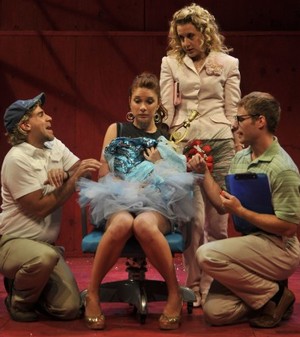
Mark Setlock, Daiva Deupree,Jenn Harris, Matthew Wilkas
(Photo: Kevin Sprague)
|
Think Little Miss Sunshine, but without an endearing little wannabe beauty queen like Abigail Breslin and a whacky but truly loving family. Cross that with the hilarious quick-changing personae of The Mystery of Irma Vep. Add not one but two non-singing Mama Roses, and you've got an idea about what to expect from Pageant Play which is having its world premiere at the Unicorn Theater.
Setlock and Wilkes who play Bob and Bobby are also the authors. Talk about writing yourself meaty parts! Though Pageant is about kids beauty queen contestants, often barely out of diapers, you won't find any little Pageant Queen contenders in frilly frocks and Mary Jane shoes sharing the stage with Bob and Bobby. Instead the play's two competing toddlers are represented by their pastel colored tulle dresses, which is not only a clever economic device but happens to allow Pageant Play to make its most incisive satirical point: the way these children's emotionally impoverished parents and the people cashing in on the Pageant craze objectify them.
Obviously, a serious subtext lurks beneath Bob and Boby's antics and the stories of the two pushy moms the player-playwright have woven into their script. But neither the savvilyy objectified children, the stories of their nutty mothers Pinky and Marge, their husbands (Pinky's a meek boy toy, Madge's an abusive jailbird), or Bob and Bobby's antics add up to quite the stuff of a really original and memorable satire. The humor is too unrelievedly broad and the characterizations so cartoonishly over the top that the more serious undertones feel wedged in and unorganic. However, thanks to the comic gifts and impeccable timing of all four cast members, there are a good many laughs to be had from this basically featherweight entgertainment. Just don't expect a groundbreaking new look at this easily lampooned cultural craziness and familial dysfunction.
Besides the talented cast, this production also benefits immeasurably from Martha Banta's lively direction and the very apt stagecraft. Special kudo to Luke Hegel-Cantarella. His clever stage design features a second story playing area with sliding doors and two additional tinselly curtained doors that come in handy when events take a four door farcical turn.
If you're looking for light summer fare with any serious thoughts well submerged beneath a lot of silly fun, you'll want to meet Bob and Bobby and the trophy obsessed Marge and Pinky and their prize poodles (oops, I mean beloved kids), Puddle and Chevrolet. Just don't expect them or their story to stay with you much longer than the ninety minutes it takes to tell their story.
PRODUCTION NOTES
Pageant Play by Matthew Wilkas and Mark Setlock
Directed by Martha Banta
Cast: Daiva Deupree (Marge), Jenn Harris (Pinkie), Mark Setlock (Bobby), and Matthew Wilkas (Bob).
Sets: Luke Hegel-Cantarella
Costumes: jessica Riesser-Milne
Lighting: Bart Fassbender
Dance Consultant: Isadora Wolfe
Stage Manager: Rafi Levavy
From July 1. Opens July 5. Closes: July 26.
Running Time: 90 minutes, without intermission
Reviewed by Elyse Sommer on July 5th
|
REVIEW FEEDBACK Highlight one of the responses below and click "copy" or"CTRL+C"
Paste the highlighted text into the subject line (CTRL+ V) Feel free to add detailed comments in the body of the email. |
Waiting for Godot
|
We are all born mad. Some remain so.—Estragon Was I sleeping, while others suffered? Am I sleeping now? Tomorrow when I wake, or think I do, what shall I say of today? —Vladimir I cannot explain my plays. Each must find out for himself what is meant. —Samuel Beckett. |
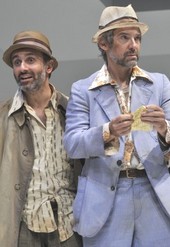
Stephen DeRosa and David Adkins in Waiting For Godot
(Photo: Kevin Sprague)
|
As Waiting For Godot has more than any other Beckett work inspired playwrights like Pinter, Edward Albee and David Mamet to create plays that were highly original yet clearly showed the influence of their spiritual father, so directors have been determined to reveal the ever puzzling hidden meanings. Anders Cato, the Unicorn . . .Godot helmer, is no exception. His directorial vision for what dramaturge James Leverett calls "a more American" Godot has not transformed this into a more action packed, neatly plotted and definitively ended summer holiday entertainment. Waiting For Godot is still a long and often painful to watch play that forces us to contemplate life as a troubling and often hellish journey with no prospect that the something better we all wait for will ever come.
Though Cato has added some effective extra vaudevillian touches to Beckett's already heavy borrowing from classic movie clowns like Charlie Chaplin, Laurel and Hardy and the Marx Brothers, an air of gloom, doom and ennui persistently clings to the two tramps and their endless waiting, waiting, waiting for the enigmatic Godot. One of the classic comic bits—Vladimir's helping Estrogen to take off his boots— was in turn deftly borrowed by Pinter for The Caretaker.
Stephen De Rosa and David Adkins who play Estragon (a.k.a. Gogo) Vladimir (a.k.a. Didi) shared the BTF Main Stage in last summer's fine revival of Love! Valour! Compassion! . De Rosa who, as Bud Hauser, had the funniest role struck me as an ideal Estragon. David Adkins, though a BTF regular, seemed a somewhat more iffy choice to play Vladimir. As it turns out, Adkins is a terrific Vladimir. De Rosa brings his natural comedic gifts to his role but, while he handles the shifts from funny to melancholy angst and despair very well, his Gogo could use a bit more depth. The two actors interact beautifully to let us see the love and mutual dependency beneath all the quarelling and comic carrying on. That bond is beautifully brought out in a scene in which the never resting, hyper Didi tenderly covers the sleeping Gogo with his coat.
The play's second pair of men, whose relationship is the direct opposite of the loving dependency of Didi and Gogo, are Pozzo (played with operatic gusto by David Schramm and his cruelly abused slave, ironically named Lucky, a truly amazing performance by Randy Harrison. Harrison is absolutely mesmerizing, whether silent except for an occasional grunt of agony as he accedes to Pozzo's orders to fetch or to dance and speak. Lucky's robotic dance macabre is indescribably memorable, as is the gibberish monologue he delivers. Mr. Cato smartly expands on that stunningly delivered scene by having Vladimir repeat it. On the other hand, the fact that Harrison never breaks the fourth wall by addressing the audience, underscored my sense that Mr. Cato's having Pozzo, Estragon and Vladimor do so did not really draw the audience more closely into the play. His doing so is actually based on references to the presence of the audience in Beckett's own original script and given the thrust seating and intimacy of the Unicorn it's understandable that he thought it would work better than it does.
A fifth character listed only as A Boy (Cooper Stanton), makes just two appearances. Like Lucky he has a master-- his being the absent Godot. Yet, even though he is dressed neatly and says he's well treated, he too is more robotic than genuinely human and thus fits this absurdly puzzling nowhere world. The setting, which is more of a room than the usual rock-and-a-tree outdoors—though no less surreal— includes an upstage door through which the Boy makes his entrances and exits.
With Robert Bolt's A Man for All Seasons on the Main Stage and Beckett's tragi-comedy at the Unicorn, Berkshire Theatre Festival once again provides Berkshire residents and visitors a chance to enjoy a substantial theater experience in the sort of lovely bucolic setting usually associated with lighter vacation fare.
PRODUCTION NOTES:
Waiting For Godot by Samuel Beckett
Directed by Anders Cato
Cast: David Adkins (Vladimir), Stephen DeRosa (Estragon), Randy Harrison (Lucky), David Schramm (Pozzo), and Cooper Stanton (Boy)
Scenic Design: Lee Savage
Costume Design: Jennifer Moeller
Lighting Design: Jeff Davis
Original Music and Sound: Scott Killian
Reviewed by Elyse Sommer August 4.
From July 29. Opens August 2. Closes: August 23.
|
REVIEW FEEDBACK Highlight one of the responses below and click "copy" or"CTRL+C"
Paste the highlighted text into the subject line (CTRL+ V) Feel free to add detailed comments in the body of the email. |
Eleanor: Her Secret Journey
Eleanor: Her Secret Journey by Rhoda Lerman
Director TBA
d The Man Who Came to Dinner. The design team includes scenic designer Lee Savage, costume designer Jennifer Moeller, lighting designer Jeff Davis, and original music and sound designer Scott Killian. Elizabeth Norment, well known to both theater and television audiences, will play the title role. One-woman play about Eleanor Roosevelt.
From August 26. Opens August 27. Closes: November 9.
Theatre for Young Audiences
Hercules
Hercules by Written and directed by E. Gray Simons III June 25 — July 26 at the Berkshire Museum in Pittsfield. $7 children, $10 adult (discount for museum members) Playing Wednesday through Saturday 11am, with no show on July 4th.
Around the World in 80 Days
Around the World in 80 Days adapted by E. Gray Simons III from the Jules Verne novel. Directed by Amy Brentano. August 6 — August 23 at the Unicorn Theatre, Monday through Saturday 11am. $7 child/student, $15 adult
Oliver
Oliver. Book, Music and Lyrics by Lionel Bart. Based on Charles Dickens's Oliver Twist Directed by E. Gray Simons III with a cast of children and adults drawn from the local Berkshire community. September 5— 13 at 7:30pm, with 2pm matinees on September 7 —at the Main Stage $10 students, $25 adults Olive
Try onlineseats.com for great seats to
Wicked
Jersey Boys
The Little Mermaid
Lion King
Shrek The Musical
Wicked
Jersey Boys
The Little Mermaid
Lion King
Shrek The Musical